Falls Church is an independent city. A stall here isn’t a Fairfax County call. If your EV dies on Broad Street, at Seven Corners, or in a Metro garage, you need EV roadside assistance that treats this jurisdiction as its own place, not a Fairfax neighborhood with a similar name.
This city isn’t Fairfax County, and it isn’t Fairfax City
Virginia has independent cities. Falls Church is one of them. Alexandria, Fairfax, Manassas, and Manassas Park are the others in this metro. An independent city isn’t inside any county. Roadside plans often file the job under Fairfax County. That can send help across a line that’s only a few blocks away.
The City of Fairfax is a different independent city. Fairfax County wraps around both. People mix the three names on the phone every day. Say “City of Falls Church” when you call. Give a street, a garage, or a landmark. Don’t say “Fairfax” and hope the dispatcher sorts it out.
About 14,593 people live here, on just over two square miles. The city sits in inner Fairfax geographically. It’s wedged between Arlington and the inner county, right on the Seven Corners knot.
Charge Pro DC is a referral line. We match stranded EV drivers with independent local operators. We don’t own trucks. We don’t employ technicians. We don’t set prices or promise an arrival window. The operator quotes you before work starts and bills you directly.
Sitting still is what empties the pack
Falls Church is small, dense, and built around a congested interchange. US-50, US-29, and VA-7 tangle at Seven Corners. I-66 runs the north edge. Stationary traffic is the range killer here. Cabin climate keeps drawing from the pack while you wait.
Summers are humid. Winter ice can show up fast. Heat and AC both cost range when you’re not moving. That’s Beltway physics, compressed into a tiny street grid.
More than 62 percent of housing here was built before 1980. Older houses, condos, and small lots often have no home plug. Drivers then depend on overnight charging wherever they can get it. A week in a Metro garage is a different failure. The 12-volt battery dies while the traction pack still has charge.
Dominion Energy is the electric utility. Dominion publishes a residential EV rate called Schedule 1EV, a voluntary Off-Peak Plan, and EV Charger Rewards. The Off-Peak Plan needs a smart meter. Confirm that on your Dominion bill. Those programs are for charging at home. No utility page we reviewed offers a service that charges a stranded car. If you’re already stopped, the rate plan doesn’t roll a truck.
Where cars actually sit dead
Seven Corners
Seven Corners is the local knot. Arlington Boulevard, Lee Highway, and Broad Street meet there. Lights stack. Lanes weave. You can lose several percent of range without leaving the interchange. If the number is already low, pull into a legal space as soon as you can. Call before the car shuts down in a merge.
Broad Street, Lee Highway, and Arlington Boulevard
Broad Street is VA-7 through the city. Lee Highway is US-29. Arlington Boulevard is US-50. These are the daily roads, not a scenic loop. Evening traffic backs up near the State Theatre. The Eden Center holds people for a long meal or a long shop. You come back to a car that sat with electronics awake. Or you come back to a 12-volt that won’t close the contactors.
East Falls Church and West Falls Church Metro
Two Metro garages hold commuter cars all week. East Falls Church and West Falls Church are long-dwell lots. You park on a work morning. You return days later. The car won’t wake, unlock, or accept a charge command. That pattern is a dead 12-volt, not an empty pack. An operator can often jump or replace the 12-volt on site. Tesla, Rivian, Hyundai, Ford, and other common EVs use a 12-volt to boot the high-voltage system.
I-66 along the north edge
I-66 is tolled dynamically inside the Beltway during peak hours. VDOT’s Safety Service Patrol covers the I-66 corridor. Drivers reach that help through Virginia 511. Published VDOT material describes incident clearance, debris, and short-term traffic control. It doesn’t describe EV charging. A patrol can make the stop safer. It won’t add miles to the pack. If you’re empty on that road, read stranded EV on I-66.
If you stall in the 495 Express Lanes after leaving town, pull to the left shoulder. Those lanes sit in the median. Stay in the car until help arrives.
What a mobile rescue actually does
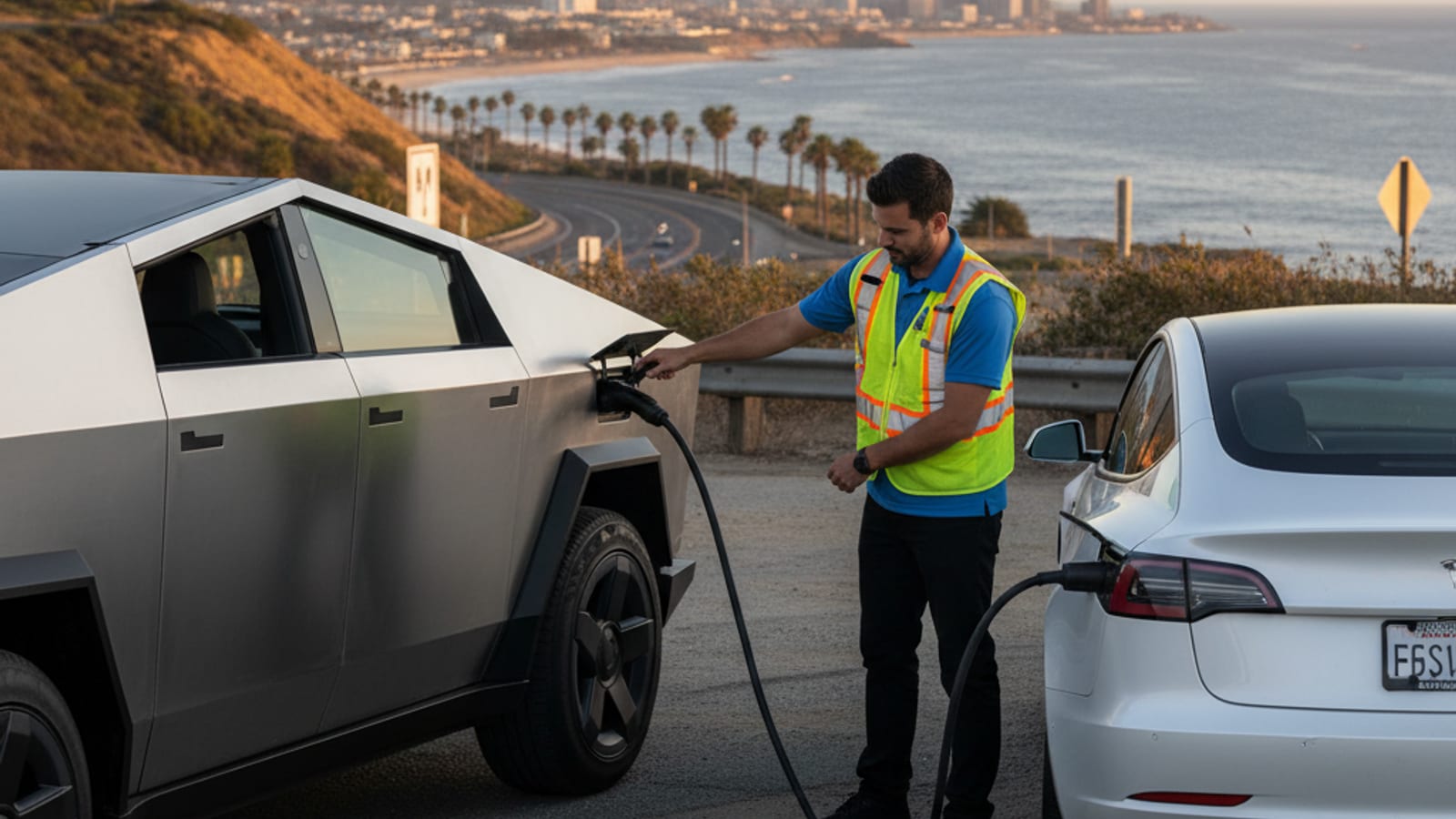
The operator brings a 240-volt Level 2 source to the car. Teslas take a native NACS plug. Other EVs take a CCS or J1772 adapter. A typical session adds 10 to 20 miles of range in 15 to 30 minutes of charging. That clock starts when the plug is in. It isn’t a travel-time promise.
Ten to twenty miles is usually enough to leave Seven Corners or an I-66 shoulder. The same visit can jump a dead 12-volt. Operators handle Tesla and every major EV brand.
For the charge visit itself, see mobile EV charging. If the pack is at zero and you can’t roll, that’s out-of-charge recovery.
What to do before the operator arrives
Stay with the vehicle if it’s safe. Put the hazards on if you’re on or near a travel lane. Seven Corners, the Metro garage ramps, and the I-66 approaches aren’t walking routes.
If the traction pack is critically low, turn climate off. Sitting with heat or AC on is how a small reserve disappears.
Don’t jump the 12-volt from a random gas car unless you know the EV steps. The 12-volt powers the contactors that connect the main pack. A bad jump can fault the car and force a shop reset.
Tell the operator you’re in the City of Falls Church. Then name the pin: Broad Street, Lee Highway, Arlington Boulevard, Seven Corners, the Eden Center, the State Theatre, East Falls Church Metro, or West Falls Church Metro. Nearby names aren’t this city. Arlington starts at the east edge. Tysons sits north. Annandale and Merrifield sit south and west. If you already crossed the line, say so.
Virginia’s disabled-vehicle rules treat an empty EV like any other stopped car. None of the three metro codes we reviewed has a special out-of-charge statute. Get out of the travel lane when you can. Stay in the car on a high-speed shoulder.
Call while the car can still creep into a legal space. A live lane is a worse place to work.
The city page, and the neighbors that aren’t Falls Church
For this jurisdiction, start at EV charging in Falls Church. If you stalled after you left, EV roadside assistance in Arlington is the next place east.
Frequently asked questions
Does a Fairfax County roadside plan cover Falls Church?
Not by default. Falls Church is an independent city. It isn’t part of Fairfax County, and it isn’t the City of Fairfax. File the call as the City of Falls Church. Give a street or a Metro garage so the operator isn’t sent into the county.
Can operators charge a non-Tesla in Falls Church?
Yes. Operators bring a NACS plug for Tesla and CCS or J1772 adapters for other EVs. Hyundai Ioniq 5, Kia EV6, Rivian, Mustang Mach-E, Chevy, and similar cars are in scope. Say the make and model on the call so the operator brings the right adapter.
Why did the car die in a Metro garage if the pack still had charge?
Long sits kill the 12-volt. East Falls Church and West Falls Church hold cars all week. The small battery runs down. The car won’t unlock or wake, even with miles in the pack. An on-site 12-volt jump or replacement is the usual fix, not a tow of the whole vehicle.
If you’re stranded in Falls Church, call (202) 629-0844. Give the city, the street or garage, the make and model, and the pack percentage if the screen still works. The operator quotes the work before anything starts.