College Park EV roadside assistance starts on the parkway, where shoulders run thin. If your EV stops on the Baltimore-Washington Parkway, stay with the car. Charge Pro DC connects stranded drivers with independent local operators. Those operators bring a 240-volt Level 2 source to your bumper. They quote you before any work starts, then bill you directly.
The parkway is a bad place to sit
The Baltimore-Washington Parkway is a National Park Service road, not a normal freeway. NPS pages describe limited access and shoulders that are narrow or gone. You can’t treat it like a wide Beltway breakdown lane. A disabled vehicle on that parkway goes to the US Park Police. Their published number is 202-610-7500. Commercial vehicles and trucks over 10,000 lb are banned there. A mobile rescue vehicle can run into the same rule. Don’t wave a box truck into a live lane. Stay in the car and keep the hazards on. Wait for Park Police to set the scene.
MDOT SHA CHART also lists MD-295 with other state primaries. You reach CHART by dialing #77 from the car. Their published help covers tire changes and jump starts. They also bring about one gallon of gas, plus radiator water. Published CHART material doesn’t describe charging an EV. Use CHART for traffic control and basic motorist aid. Use a quoted operator when the pack is empty. Use the same call if the 12-volt is dead.
Maryland’s disabled-vehicle rules live in Transportation Article Title 21. DC, Maryland, and Virginia code were reviewed for this page. None of those codes singles out an empty traction pack. An EV that can’t move is a disabled vehicle. The stay-put rules match any other stalled car.
Beltway lanes versus parkway rules
College Park’s north edge meets I-95 and I-495. That junction is interstate pavement with CHART coverage. The parkway is a different road with a different phone tree. Drivers mix them up because both sit at the edge of town. On the Baltimore-Washington Parkway, Park Police own the stall. On the Capital Beltway general lanes, those lanes are free. Dial #77 for the published CHART path on that interstate. Don’t borrow Express Lanes advice here. The 495 Express Lanes sit in Virginia’s Transurban system. College Park’s Beltway touch is the Maryland side.
US-1, Baltimore Avenue, is the third stall pattern. It crawls through campus and spends range in stop-and-go. You may still have a legal curb or a garage ramp. That’s easier to work than a parkway with no shoulder. If you can still roll, leave the travel lane before the estimate hits zero.
How College Park spends a charge
College Park sits in Prince George’s County on the flat Anacostia lowland. Census ACS 2019-2023 figures put the population at 34,397. The land area is 5.61 square miles. That compact footprint still carries heavy through traffic. US-1 crawls through campus most of the day. The I-95/I-495 junction just north is among the metro’s busiest. MD-193, University Boulevard, is another local corridor. Kenilworth Avenue, MD-201, is another.
Summer humidity here pushes drivers onto the AC. Winter ice on the same lowland cuts range the other way. A Recurrent Auto study covered more than 30,000 EVs. A typical car keeps about 80 percent of range at 32F. At 20F that figure is about 70 percent. Cabin heat is the drain, not a grade. Sitting still in Beltway traffic still spends the pack. Climate control on and no miles gained is a local problem. The January 2022 I-95 shutdown sits just south of this metro. Drivers sat overnight with the heat running and watched numbers fall.
This is a university town first. The University of Maryland campus and its garages hold cars for long stretches. The College Park Metro garage repeats that weekday sit. Xfinity Center event parking adds more long dwell after events. The University of Maryland Golf Course lots also hold cars for long sits. Cars that sleep for days are where 12-volt calls concentrate. The traction pack can still show a healthy percent. The small battery that wakes the car is the one that failed.
ACS 2019-2023 data show 51.1 percent of housing here was built before 1980. Research on this town is blunt about the renter mix. Older off-campus housing makes public charging the default for most students and renters. That’s not a claim about missing stations. It’s a claim about where people actually plug in. A long US-1 errand day can empty a pack that looked fine at noon. A slow crawl to the Beltway finishes the job.
Empty pack versus a 12-volt that won’t wake
EV roadside assistance in College Park is two different jobs. Tell dispatch which one you have.
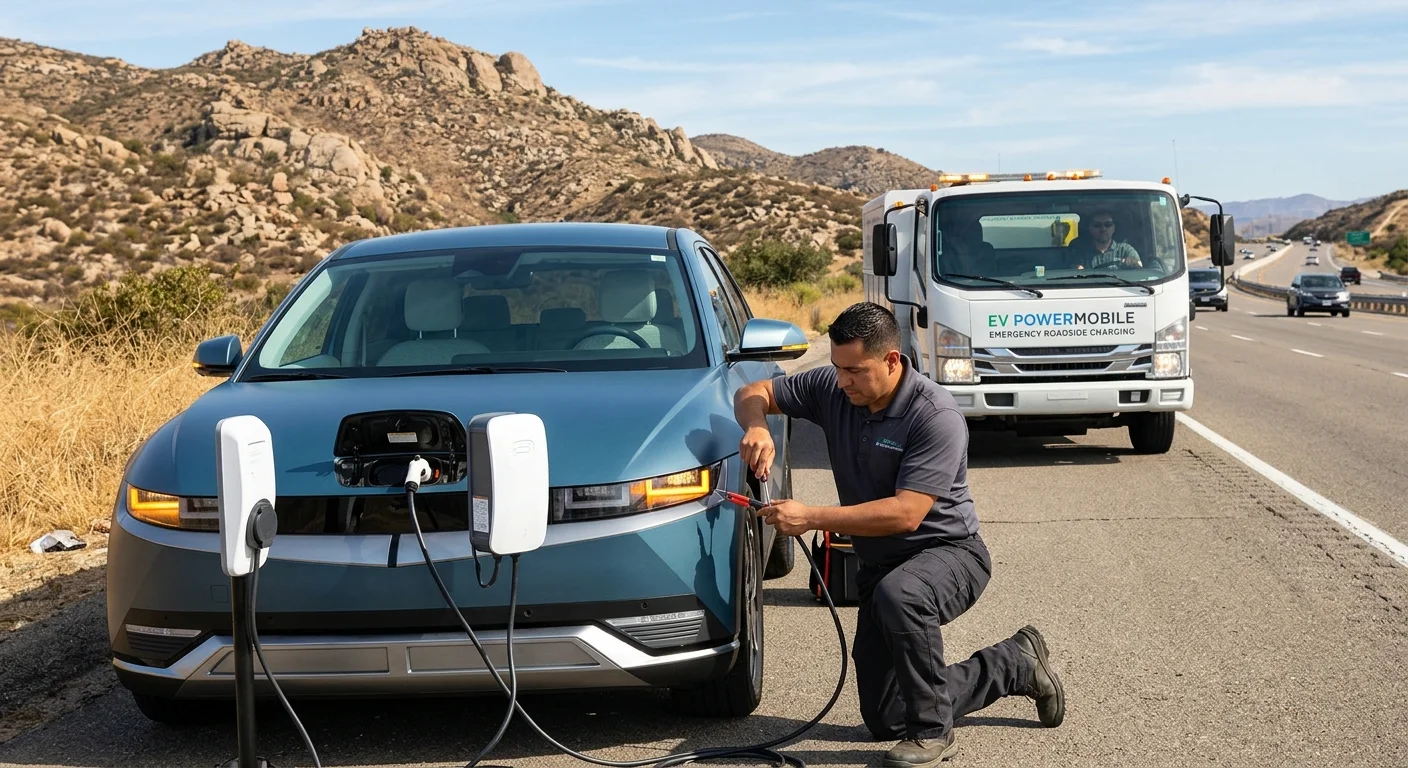
If the range hit zero, you need out-of-charge recovery. The operator brings a 240-volt Level 2 source to the car. A native NACS plug handles Teslas. CCS or J1772 adapters cover non-Tesla EVs. Typical charging time puts 10 to 20 miles back in 15 to 30 minutes. That window is time on the plug. It isn’t an arrival time, and Charge Pro DC doesn’t promise one.
If the car won’t wake, start with the 12-volt. Dark screens, locked doors, and a silent cabin point there. Tesla 12-volt battery jump work happens on site. Most cars move after a jump. If the battery won’t hold a charge, ask the operator for a replacement quote. You skip a tow to a shop just to hear the same diagnosis.
Tesla, Rivian, Ford, Hyundai, Kia, Chevy, and other major EV brands are in scope. Say the model when you call. The operator confirms the connector before anyone leaves.
Charge where you sit, or wait on a hook
A dead EV doesn’t automatically need a tow. Read this charge-versus-tow guide if you’re weighing both. Charge Pro DC doesn’t set prices. The independent operator quotes you before starting and bills you directly. Compare that quote to a hook, a ride, and time away from the car. We couldn’t confirm a Prince George’s County tow fee that’s safe to print. We also couldn’t confirm a College Park figure. Maryland leaves private-property towing and county ordinances to local code. Confirm any tow price with the company that would do the hook.
A tow is the right call when energy isn’t the problem. A flat, a stuck charge port, or a drivetrain fault needs a shop. An empty pack or a failed 12-volt usually needs power at the car.
On the parkway, access comes first. Report the stall to US Park Police. Let them decide how a commercial vehicle can approach. Then take the operator’s quote. For the longer parkway sequence, use this Baltimore-Washington Parkway guide.
First minutes after you stop
If you still have a sliver of range, leave the travel lane when it’s safe. On the parkway that may be a thin shoulder. It may be no shoulder at all. Don’t walk the road looking for a plug. Stay with the car.
Call US Park Police at 202-610-7500 on the Baltimore-Washington Parkway. On the Capital Beltway or other listed state primaries, try #77 for CHART. Those patrols manage the scene. They don’t publish EV charging. Pepco serves Prince George’s County. Its published EV program is Pepco EVsmart. That program covers home and multifamily charging equipment. Pepco doesn’t publish a service that charges a stranded car. A utility account won’t get you moving on the parkway.
Then request a quoted local operator. Give the nearest interchange, mile marker, or lot name. US-1 through campus is a clear pin. So is the Beltway junction just north of town. University Boulevard and Kenilworth Avenue work too. A space in the Metro garage is simpler than a live lane. A campus garage or an Xfinity Center lot is simpler too. If you can still creep to a legal parking stall, do that. If you can’t, stay put and wait.
What Charge Pro DC does, and doesn’t do
Charge Pro DC serves College Park, the District, Maryland, and Virginia. We’re a referral line, and we don’t hold a trade license. We own no trucks, no chargers, and no yard. We don’t employ technicians. The College Park page lists the local corridors we cover. The pros we connect you with are licensed and insured. They do the work, and you hear the price first.
Greenbelt is next along the same parkway. Hyattsville sits on US-1 toward Washington. Laurel is another nearby parkway town. A stall that starts in College Park sometimes ends in one of those. This Greenbelt roadside guide covers the Metro lot and the parkway there.
If you rent near campus and want a Level 2 later, start on pepco.com. Read the current Pepco EVsmart terms there. Published rebate amounts change. We’re not printing a number we can’t lock to today’s page. A licensed electrician answers the panel question. That’s a different day from a roadside top-up.
When the call is the right one
Call when a campus garage car won’t wake. Call when the pack hit zero on Baltimore Avenue. Call when you’re already on the parkway and the next exit looks too far. You don’t need a speech. Location, make, and what the screens show are enough.
Call (202) 629-0844 to get matched with an operator. The operator quotes you, then bills you.
Frequently asked questions
What should I do first on the Baltimore-Washington Parkway?
Stay with the car and switch on your hazards. Report the disabled vehicle to US Park Police at 202-610-7500. Commercial trucks over 10,000 lb are banned on that NPS parkway. Wait for their direction before anyone works around the car. Then request a quoted 240-volt top-up or 12-volt jump.
My Tesla won’t start in a campus garage. Is that the pack?
Usually it’s the 12-volt. Dark screens and stubborn doors point there, not to an empty traction battery. Campus garages hold cars for days, and that dwell is where 12-volt failures concentrate. A jump at the car wakes most Teslas. If it dies again, ask the operator for a replacement quote on site.
Do operators in College Park handle non-Tesla EVs?
Yes. The pros we connect you with bring a native NACS plug. They also carry CCS or J1772 adapters. That covers Rivian, Ford, Hyundai, Kia, Chevy, Polestar, Nissan, and most other EVs sold here. Tell dispatch the model so they confirm the connector before they roll.