A stall in Clinton is often a parkway problem first. Southern Prince George’s County sits on Branch Avenue, the Beltway, and National Park Service roads. On those parkway stretches, a disabled EV is a US Park Police call. EV roadside assistance here means a quoted local operator at the car. They bring 240 volts or a 12-volt jump after the scene is held.
Why a Clinton stall is not an inner-metro stall
Clinton is a spread-out community in southern Prince George’s County. It’s not an incorporated city. Census figures put the population at 38,756 across about 25 square miles. That’s a lot of two-lane approach road between home, shopping, and the Beltway.
The spine north is Branch Avenue, which is MD-5. Woodyard Road (MD-223) and MD-337 feed the same grid. I-95 and I-495 sit at the northern edge of the community. Suitland Parkway is a National Park Service road. The Baltimore-Washington Parkway is NPS ground too, farther toward Laurel and Greenbelt.
Those parkways are limited-access scenic roads. Published NPS rules ban commercial vehicles and trucks over 10,000 pounds. Shoulders are narrow or missing. You can’t treat a stall there like a wide Beltway shoulder.
NPS reports a disabled vehicle on the Baltimore-Washington Parkway to US Park Police. The published number is 202-610-7500. Suitland Parkway is the same agency’s ground. Stay with the car if it’s safe. Put the hazards on. Don’t walk the pavement looking for a plug.
Maryland’s disabled-vehicle rules live in the Transportation Article Title 21. They cover an empty EV the same as any other car. None of the DC, Maryland, or Virginia codes reviewed has a special out-of-charge statute. You’re a disabled vehicle. That’s the legal category.
Park Police, CHART, or a quoted operator
On an NPS parkway, Park Police own the scene. Tell them you’re in an electric car that can’t move. Follow their traffic control before anyone plugs in. A mobile charger can’t work if there’s no legal place to stand.
On state primary roadways, MDOT SHA CHART is the motorist patrol. Dial #77 from I-495, I-270, US-50, or MD-295. CHART techs change tires, jump-start, and add about a gallon of gas. Published CHART pages don’t describe charging an EV pack. Use CHART for cones, a 12-volt jump, and getting you off the travel lane.
The Capital Beltway general lanes are free. The 495 Express Lanes sit in the median. Transurban’s published note is to pull to the LEFT shoulder there. Stay in the car until help arrives. Express Assist handles minor mechanical issues and will call a tow. It doesn’t fill an EV.
Pepco serves most of Prince George’s County. SMECO starts toward the southern edge of Clinton. Confirm the serving utility by address. Neither one publishes a stranded-car charging service. Pepco EVsmart is a home and multifamily charger program, not a roadside truck.
The Branch Avenue commute is what empties the pack
Most Clinton traction-pack calls start as an ordinary south-county drive. You leave with what looked like enough range. Branch Avenue traffic stacks toward the Beltway. Cabin AC runs in the humidity. Indicated miles fall faster than the map suggested.
Humid summers here make cooling expensive in battery terms. Icy winters do the same with heat. Recurrent Auto studied more than 30,000 EVs. A typical car keeps about 80 percent of range at 32F. It keeps about 70 percent at 20F. Cabin climate is the reason, not a mystery defect. Sitting still with heat or AC on burns charge without covering ground. That’s a Beltway crawl as much as a mileage problem.
Clinton sits where suburb gives way to farmland. Approach roads are longer and slower than inner Prince George’s. You feel that on MD-223 and on the last miles of MD-5. Extra stops along Branch Avenue shopping add the last miles you didn’t budget.
About 39.6 percent of Clinton housing was built before 1980. Those houses weren’t designed around a driveway Level 2 plug. Some owners still charge at home. Others live with overnight Level 1 or a workplace cord. Forgetting to plug in is a real call pattern. So is a week of short trips that never quite refill the pack.
Named public charging sites change, and this page won’t guess where they sit. The useful fact is where the car actually sits. Why the pack ran short matters more than a station list.
The Branch Avenue Metro garage and other long sits
Branch Avenue Metro is the southern end of the line. The garage is a long-dwell lot. Cars sit all week while owners ride the train. The traction pack is often still healthy. The 12-volt isn’t.
That small battery runs locks, computers, and the wake-up sequence. When it dies, the car looks fully dead. The app won’t connect. Doors may not answer. Range on a last screenshot doesn’t help. You need a 12-volt jump or replacement more often than you need a trailer.
The same 12-volt pattern shows up after a long sit at Clinton shopping on Branch Avenue. It shows up at MedStar Southern Maryland Hospital Center after a long visit. Airport economy lots across the region teach the same lesson. A week parked is harder on the 12-volt than on the pack.
Joint Base Andrews sits on the edge of the community. Access is restricted. Don’t assume a civilian operator can enter. If you stall on the installation, follow the gate and security instructions first.
Nearby Suitland, Oxon Hill, and Largo share these south-county roads. A stall that starts in Clinton can roll onto Suitland Parkway toward the District. That’s why parkway rules belong on a Clinton page.
What a mobile rescue actually brings
Charge Pro DC is a referral line. It matches stranded drivers with independent local operators. It doesn’t own trucks. It doesn’t employ technicians. It doesn’t set prices or publish an arrival clock.
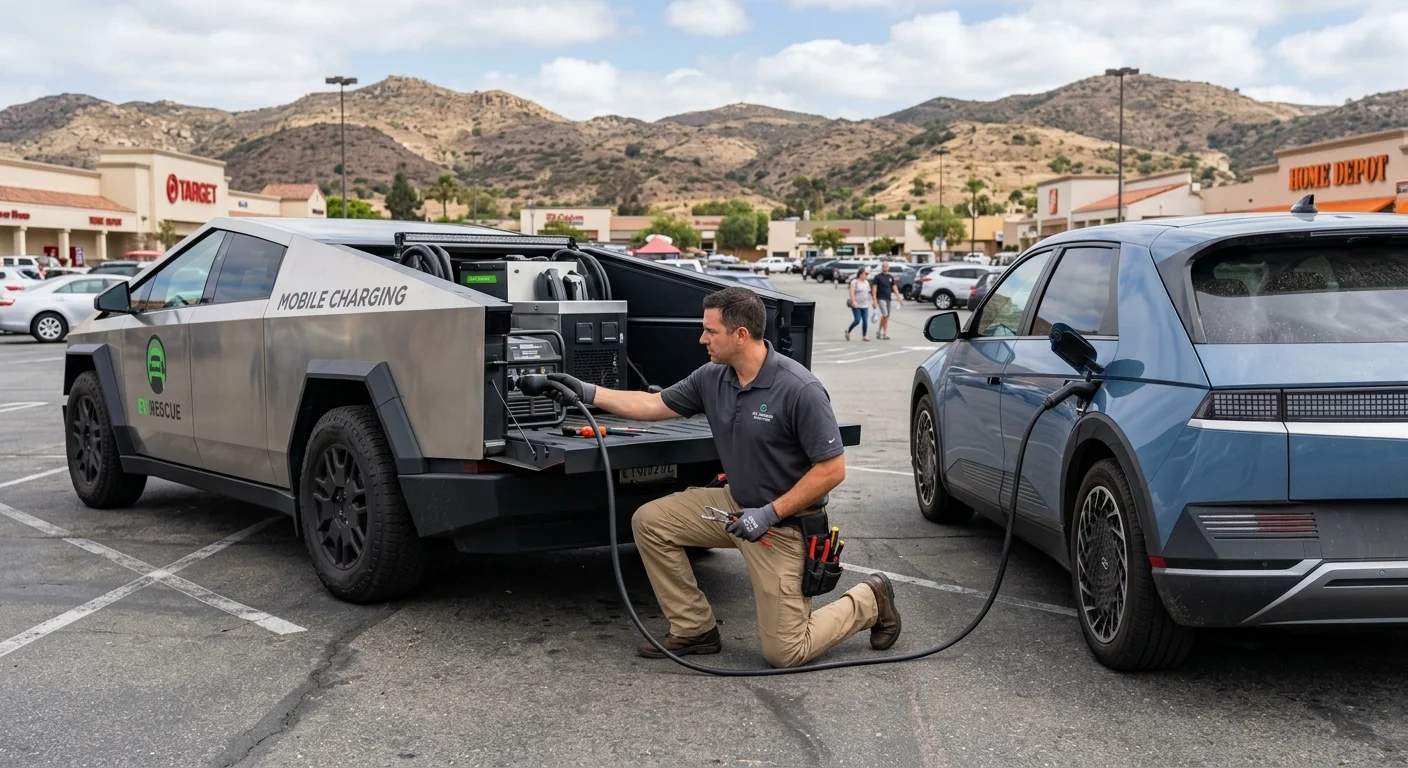
The operators we connect you with bring a 240-volt Level 2 source to the car. Teslas take a native NACS plug. Other EVs take CCS or J1772 through an adapter. Typical charging time, never travel time, is 15 to 30 minutes. That usually adds about 10 to 20 miles of range. That’s a top-up so you can drive, not a full overnight fill.
They also jump or replace a dead 12-volt on site. They handle Tesla and every major EV brand. Mobile EV charging is that 240-volt visit. It’s not a tow, and it’s not a shop repair.
A public charger is still the right place for a long fill once you can roll. Pepco EVsmart publishes a residential Level 2 smart-charger rebate for Prince George’s addresses. Confirm the current amount on Pepco’s own page before you count on it. No utility page reviewed for this metro offers to charge a car that’s already stranded.
Empty pack, dead 12-volt, or a port that won’t release
Sort the failure before you call anyone.
If the display is awake and range is at or near zero, the traction pack is empty. Stay put if you can’t make the next safe stop with margin. Hazards on. Then ask for a 240-volt top-up. Coasting a parkway with no shoulder is how a low pack becomes a Park Police incident.
If the car won’t wake, start with the 12-volt. That’s true on a Tesla, a Ford, a Hyundai, a Chevy, and most other EVs. A jump on site often brings the high-voltage system back. If the same 12-volt dies again in a day, replace it on site. That’s usually the cleaner move. Repeated jumps on a failed battery waste the afternoon.
A stuck charge port is a smaller pile of calls. Forcing the latch can break it. Let someone who works on EVs release it.
National club roadside plans and Tesla’s own roadside offering vary by contract. Many of them send a tow. Fewer of them bring 240 volts to a Clinton lot. If your plan only tows, you still need a quoted local operator for a charge.
When a tow is the right call, and when it isn’t
Towing is right when the car won’t take a charge. It’s right when something is mechanically wrong. It’s right when Park Police need the vehicle moved and there’s no legal place to plug in.
If the car is only empty, a tow is extra handling. You wait for a hook. You wait for a destination. You wait again to charge. On-site charging leaves the car in your hands. You drive it off.
Maryland private-property towing and Prince George’s County ordinances set their own rules. Confirm the county ordinance before you assume any fee. This page won’t invent one. For the empty-pack comparison, mobile charging versus a tow is the cleaner read.
If you’re already on Suitland Parkway, use the same no-shoulder playbook. The Suitland parkway stall notes cover that road. The Baltimore-Washington Parkway out-of-charge steps cover the Park Police number and what to do while you wait.
Who to call, in order
Safety, then power.
On Suitland Parkway or the Baltimore-Washington Parkway, call US Park Police first. Use 202-610-7500 as NPS publishes it for a disabled vehicle on the Baltimore-Washington Parkway. Say you’re in an EV. Wait for their direction before you invite a commercial vehicle.
On I-495 or other state primary roads, #77 reaches CHART. Ask for scene protection. Don’t expect a pack charge from that truck.
On Clinton streets and Branch Avenue lots, wait until you’re out of traffic. Then call for a quoted operator. Give the cross street and the lot name. Say whether the car will wake.
Charge Pro DC serves Clinton and the rest of Maryland, the District, and Virginia. The Clinton charging page is the local hub for this community.
The operator, not the referral line, sets the price. The operator also gives you an arrival window on that call. You hear both before work starts. This site doesn’t publish an arrival promise. MD-5 and Beltway traffic don’t honor one.
When you should call
Call when the pack is empty and you can’t make the next safe stop. Call when the car won’t wake after a week in the Branch Avenue Metro garage. Call when you’re on Woodyard Road or MD-5 with no usable range. Call once a parkway stall is reported and the lane is held. Then you can ask for 240 volts.
Don’t use a mobile visit to skip a home plug you already have working. Don’t ask an operator onto Joint Base Andrews without clearance. Don’t walk a parkway with missing shoulders looking for a station.
Stay with the vehicle if it’s safe. Keep climate control modest so a low pack lasts. Keep doors shut if people are waiting with you.
When you want a quoted local operator, call (202) 629-0844. Charge Pro DC connects you with an independent pro who quotes before starting and bills you directly.