When a DC-area EV won’t move, ev battery types aren’t a chemistry quiz. The split that matters is traction pack versus 12-volt. That’s the first question a local operator asks.
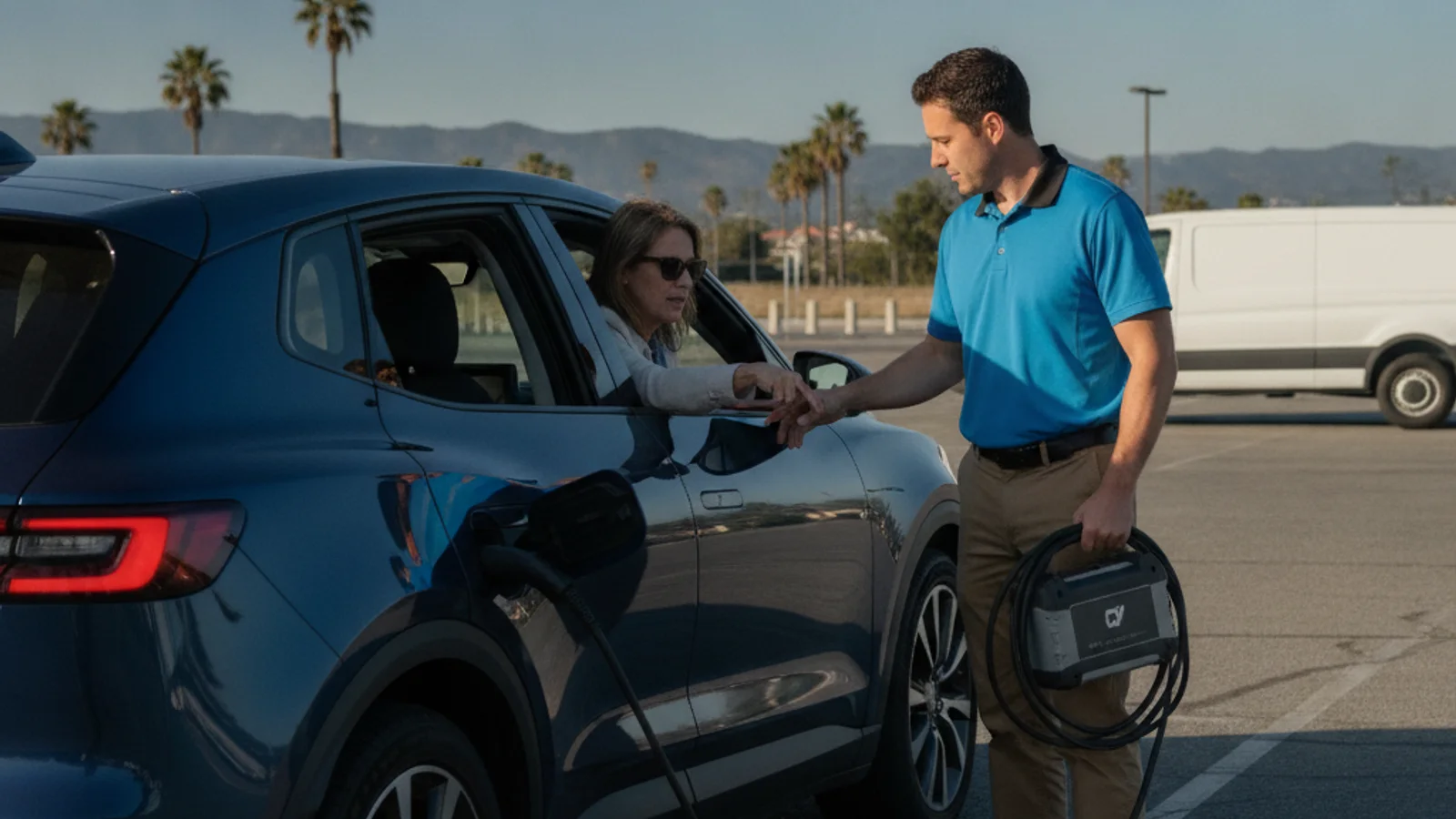
What a local operator asks first
A matched operator isn’t asking which cell supplier built your pack. They’re asking if the car is out of driving energy. They’re also asking if the small battery that wakes the computers has failed.
That question is the same on I-270 through Rockville. It’s the same in a Tysons garage after a long sit. It’s the same after a week in a Dulles parking garage.
Charge Pro DC is a referral line. It matches stranded drivers with independent local operators. The operator quotes you before any work starts, and they bill you directly. The brand doesn’t own the truck, and it doesn’t do the work.
Two batteries, two jobs
Your EV carries two battery systems. The traction pack stores the energy that turns the motors. It’s what you plug in at home, and it’s what a public station fills. The 12-volt battery is the other system. It doesn’t drive the wheels. It runs the computers, the locks, the lights, and the screen. It also closes the relays that let the traction pack connect. If that small battery dies, the car can go fully dark. A full pack can still be sitting under the floor. That’s why “dead EV” is a weak phrase on the phone. Say whether the doors and screen went dark. Or say the display still works and the range hit zero.
Tesla owners can read Tesla won’t wake: 12 volt battery or high-voltage pack for that fork. It helps you name the failed system before anyone is matched.
How this metro produces both failures
Travelers leave cars at Reagan National and Dulles for a week. MWAA lists complimentary EV charging at Reagan National. It’s on Level 1 of Parking Garages 1 and 2. Dulles publishes Level 2 charging in Garage 1 and Garage 2. A car that sat for days and won’t wake is often a 12-volt failure. WMATA park-and-ride garages show the same week-long pattern.
Cabin heat and AC come from the traction pack. Sitting on the Capital Beltway with climate running spends charge without covering distance. Recurrent Auto’s winter range study used more than 30,000 EVs. A typical EV keeps about 80 percent of range at 32F. At 20F it keeps about 70 percent. Dulles runs colder and snowier than Reagan National. Loudoun, upper Montgomery, and Prince William see harder freezes. The District and the inner Virginia core run milder.
Census ACS 2019-2023 figures put Takoma Park’s pre-1980 housing share at 90.0 percent. Annandale sits at 79.8 percent. Many of those homes never got a wall unit. A missed workplace or public plug shows up as a low traction pack. Ashburn’s pre-1980 share is 3.1 percent. Home charging is common there. The roadside call is often a dead 12-volt after a garage sit. None of that is chemistry. It’s which system to name first.
Chemistry can wait until you’re home
Search threads love pack chemistry and cell suppliers. None of that changes tonight’s call. Chemistry matters when you’re comparing cars to buy. It doesn’t decide whether you need energy, a 12-volt jump, or a ride. An operator on the Capital Beltway isn’t testing cell type over the phone. They’re asking what the dash says, what still wakes, and where the car sits. Charge Pro DC has no verified pack-capacity, voltage, or cell-mix figures for any model. Those numbers don’t belong in a roadside decision. If you need them, use the current owner’s manual.
Give the operator the model and the exact message
Two facts beat a long guess. Name the exact vehicle, then read the exact dash wording. Make, model, and year matter because 12-volt access and approved jumps differ. A Tesla frunk post isn’t a Rivian layout. A Mustang Mach-E isn’t an Ioniq 5. That’s why non-Tesla EV rescue is its own call. Zero miles, or a percent at empty, points at the traction pack. A black screen or a handle that won’t present points at low voltage. So does a warning that names the 12-volt or auxiliary battery. Read the words out loud. “It died” tells them nothing. “The screen went black and the app can’t wake it” tells them a lot. Interior lights, the phone app, and the key fob ride on the 12-volt system. If some of those still answer while the car won’t drive, say so. After the stop, EV 12-volt replacement: signs it’s failing and what to do covers the lasting fix. What happens when an EV 12 volt dies in a garage or airport lot covers the long-sit version.
Charge, jump, or a ride
Once the vehicle and the message are clear, most calls fall into three buckets. A charge fits when the traction pack is empty and the car can be reached. That’s a mobile EV charging visit. Operators typically bring a 240-volt Level 2 source. They use a native NACS plug. Non-Tesla EVs get a CCS or J1772 adapter. Charging time is usually 15 to 30 minutes. That adds about 10 to 20 miles of range. That’s charging time, never an arrival time. A jump may fit when the 12-volt has failed. It only fits if the manufacturer allows a jump on that model. Don’t copy a video filmed on another make. Confirm the steps with the operator and the manual. Tesla 12-volt work is its own path on Tesla 12V battery jump. A ride fits when the cause isn’t confirmed, or the car isn’t safe to reach. It also fits when the manufacturer’s process for that message sends you to a shop. Ask if they aren’t sure. A guess is worse than saying you don’t know yet.
Pepco, Dominion Energy Virginia, and NOVEC publish home-charging programs. Pepco’s program is EVsmart. Dominion names Schedule 1EV, an Off-Peak Plan, and EV Charger Rewards. No utility page reviewed offers a charge for a stranded car. Highway patrols won’t sort the battery type either. VDOT’s Safety Service Patrol covers Virginia interstates, including the I-66 corridor. Published material describes incident clearance. It doesn’t describe EV charging. Reach them through Virginia 511. MDOT SHA CHART publishes tire changes and jump starts. Dial #77 on I-495, I-270, US-50, and MD-295. CHART’s published list doesn’t include charging an empty traction pack. No DDOT motorist-assistance patrol turned up for the District. Drivers there use MPD, a private plan, or US Park Police on the parkways. On the 495 Express Lanes, pull to the left shoulder. Those lanes sit in the median. On the 95 and 395 Express Lanes, pull to the nearest shoulder. Stay in the car until help arrives. Transurban’s Express Assist helps with minor mechanical issues and will call a tow. It doesn’t tow, and it doesn’t charge an EV. National Park Service parkways ban commercial vehicles and trucks over 10,000 lb. Report a disabled vehicle on the Baltimore-Washington Parkway to US Park Police at 202-610-7500. The Woodrow Wilson Bridge sits at the meeting of Virginia, Maryland, and the District. Disabled-vehicle rules in all three codes apply to an EV like any car. None of the three codes reviewed has a special out-of-charge section.
Check your manual, then decide
This article can’t tell you where your jump posts sit. It can’t decode every warning string. It can’t say whether your manufacturer allows a roadside 12-volt jump. Those details change by make, model, and year. Start with the current owner’s manual for your exact car. Tesla’s service docs and Rivian’s owner resources are next if the manual is silent. Once you’re moving, the DC-area EV charging hub covers later trips. It isn’t a substitute for the manual on a dead car. If you truly can’t tell which battery failed, say that. Say you don’t know if this is the pack or the 12-volt.
When to call for a match
Call when the car won’t power on or won’t take a charge. Call when a warning shows up that you can’t classify. Bring the make, model, year, and the message word for word. The matched operator uses that to sort a charge, a jump, or a ride. Charge Pro DC serves the District, Maryland, and Virginia. If you need a match, call (202) 629-0844. We’ll connect you with a local EV rescue operator.