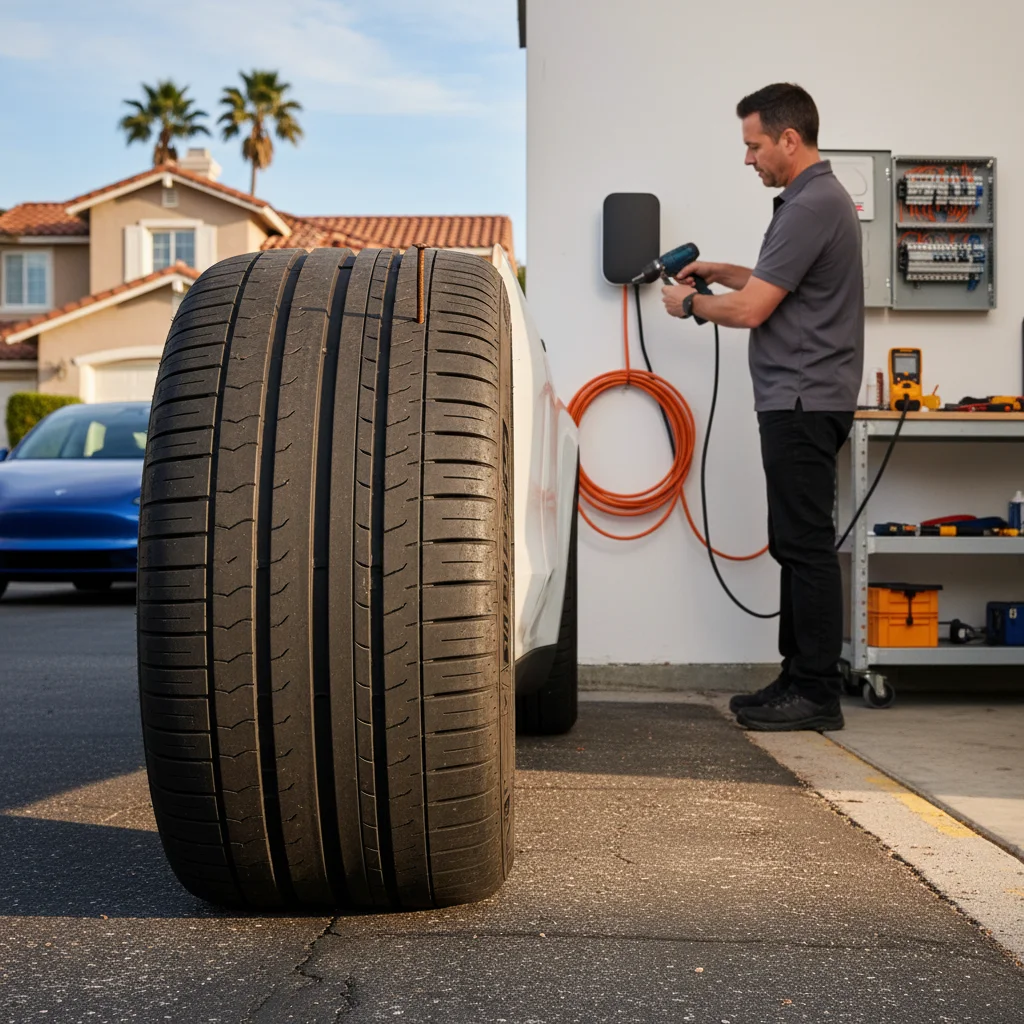
Tesla tires are acoustic foam-lined, not run-flat. The short answer is no. The longer answer matters here because NPS parkways in this metro have narrow or absent shoulders, and a Tesla with a flat cannot limp far on a foam-lined tire that lost pressure.
Why Tesla skipped run-flat
Run-flat tires have reinforced sidewalls that support the car at zero pressure, usually up to 50 miles at under 50 mph. The trade-offs are weight, rolling resistance, road noise, and replacement cost. For an EV where every pound costs range, those trade-offs are deal-breakers. Tesla chose acoustic foam-lined tires instead. The foam bonded to the inside of the tire absorbs cavity noise. That is why a Model Y at highway speed is quieter than a comparable gas car.
Acoustic foam is a comfort feature, not a flat-tire safety net. Lose pressure and the tire behaves like a normal tire with no air. You stop where the air runs out. On a narrow parkway shoulder, that is a real problem.
Why the spare is missing too
Tesla’s skateboard battery pack forms the floor of the car, so there is no spare tire well. A spare plus jack plus lug wrench adds 40 to 50 pounds, which directly reduces range. Tesla has been removing the spare across Model 3, Model Y, Model S, Model X, and Cybertruck for years. Most owners carry a Tire Repair Kit with sealant and a small 12V air compressor instead.
The kit is a temporary fix. It works on small punctures in the tread. It does nothing on sidewall damage, large punctures, or blowouts. Many tire shops refuse to patch a tire that has had sealant in it, because the goo damages the TPMS sensor and complicates the repair. Most of those shops will tell you a sealed tire cannot be properly patched.
Why this is worse on a parkway
NPS parkways run through this metro. The Baltimore-Washington Parkway and the George Washington Memorial Parkway are limited-access scenic roads with narrow or absent shoulders. They ban commercial vehicles and trucks over 10,000 lb. A disabled vehicle on the Baltimore-Washington Parkway is reported to U.S. Park Police at 202-610-7500. There is no tow shoulder wide enough to park a flatbed safely while traffic moves at highway speed past the scene.
You can limp a run-flat tire for a short distance at low speed. You cannot limp a foam-lined Tesla tire at zero pressure. The car stops where the air runs out. On a parkway with no shoulder, that means a live lane or a tight pull-off. Either way, you need a tire service or a tow that can reach a safe spot.
The 495, 95, and 395 Express Lanes sit inside the general lanes. On the 495 Express Lanes, Transurban says to pull to the left shoulder because those lanes run in the median. On the 95 and 395 Express Lanes, pull to the nearest shoulder. Transurban’s Express Assist runs on those lanes for minor mechanical issues and will call a tow. It does not change tires.
What to do when the TPMS light comes on
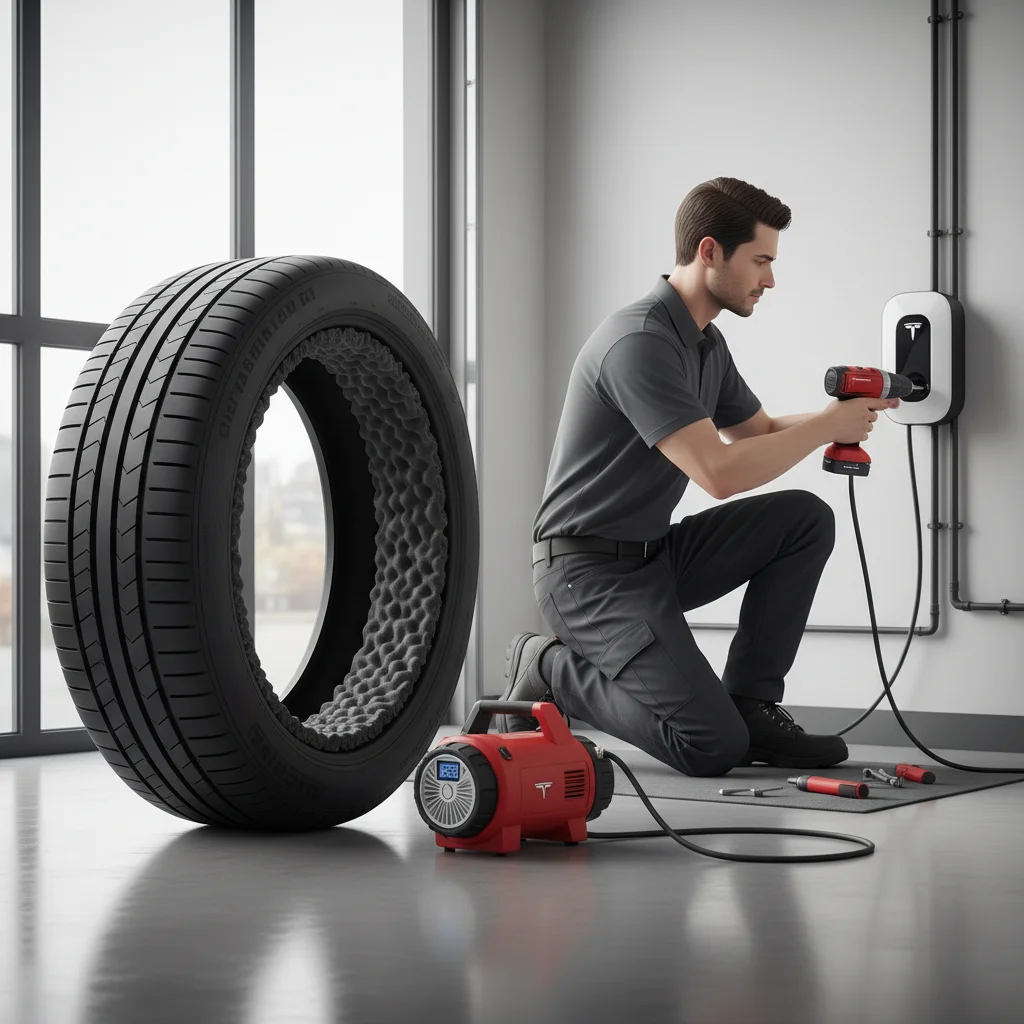
The Tire Pressure Monitoring System tells you which tire is low and how low. Pull over as soon as you can do so safely. Driving on a severely underinflated tire destroys the sidewall and can damage the alloy wheel. That is what turns a repairable nail into a tow.
If the puncture is small and in the tread, the Tire Repair Kit can get you to a tire shop. If you have a portable 12V air compressor, you can re-inflate after the sealant coats the puncture. If the puncture is large or in the sidewall, the kit is useless. Stop, set hazards, and call for help.
If the car is on a parkway, the first call is to U.S. Park Police at 202-610-7500 for the Baltimore-Washington Parkway. For other NPS parkways in this metro, the Rock Creek and Potomac Parkway, the Clara Barton Parkway, or the Suitland Parkway, the same rule applies: report to Park Police. They can dispatch a unit and clear the lane while you wait for a tire service.
What the pros we connect you with handle at the tire
The pros we connect you with are licensed and insured independent operators. A tread-area nail on a Tesla tire can sometimes be plugged at the curb. A sidewall gash or a shredded tire still needs a tow. If the pack ran low while you waited for the tire job, the operator brings a 240-volt Level 2 source to the car. They typically add 10 to 20 miles of range in 15 to 30 minutes of charging. That is charging time, never an arrival time.
A 12-volt jump or replacement is also part of that visit. The operator quotes you before starting and bills you directly. They bring a native NACS plug, plus CCS or J1772 adapters for non-Tesla cars. Charge Pro DC is a referral line for the District, Maryland, and Virginia. We don’t own trucks, employ technicians, set prices, or hold a trade license.
Where this pattern hits hardest in this metro
Older apartment stock across the inner ring sits at the curb more than in a garage. Census ACS figures put pre-1980 housing at 70.3 percent in Washington, 90.0 percent in Takoma Park, 79.8 percent in Annandale, 73.1 percent in Wheaton, 61.2 percent in Bethesda, and 69.1 percent in Silver Spring. Many of those blocks don’t have a dedicated home charger circuit. A car parked outside overnight on a cold night loses pressure faster than a car in a heated garage.
Tysons Corner Center, Bethesda Row, and Westfield Montgomery hold cars through long visits. So does the Dulles Economy Lot, where a weeklong sit can leave the tires low on pressure before you ever leave the lot. The Reagan National garages run warmer and drier, which helps, but a long stay still costs pressure.
For more on what Tesla roadside actually does for a flat tire, see our Tesla roadside tire repair guide. For the broader 12-volt trap that shows up after a tire job, see our Tesla 12-volt failure signs guide.
When to call Charge Pro DC
Call us when the flat is on a parkway, when the patch kit failed and you need a quoted local visit, or when a 240-volt top-up is the second job after the tire. Have model, pin, tire location, and the warning text from the touchscreen ready. Call (202) 629-0844 and we’ll connect you with a local EV rescue operator.