A Tesla that hits zero on the road needs a 240-volt mobile boost. The pack won’t move itself. The right move is to stay with the car, get it to a safe spot, and call for a quoted local operator who can bring the missing range to where the car sits.
Around DC, Maryland, and Virginia, the loudest corridor for this pattern is the Beltway at rush hour. A driver who ran the pack down to single digits in slow I-495 traffic watches the dash drop to zero as the cars barely move. The same pattern shows up on I-95 through Springfield and Alexandria, on I-66 inside the Beltway, and on I-270 up through Rockville. The cabin heat on a winter Beltway crawl drains charge without covering miles. The dash looks fine at the start of the commute. It doesn’t look fine at the end.
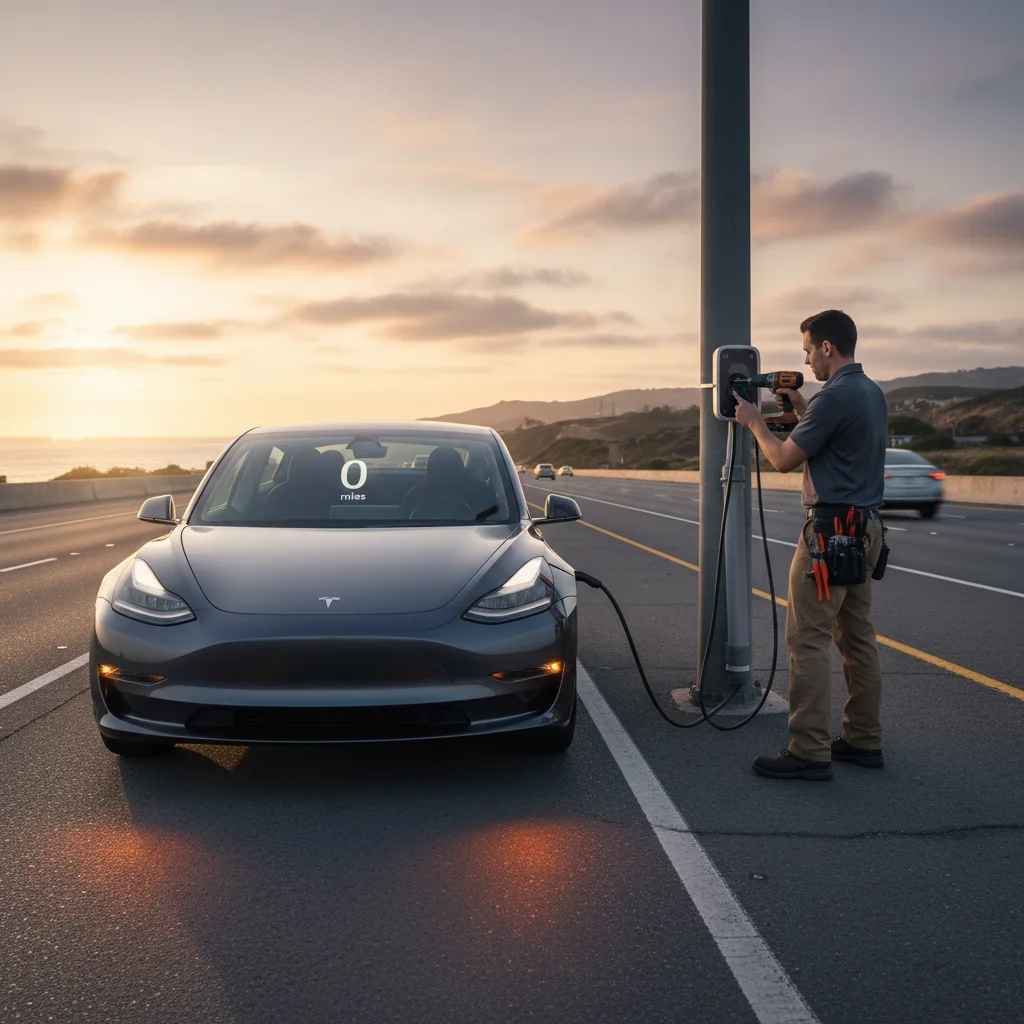
What to do in the first minute
The car is still drivable for a few seconds after the range hits zero. Use that window.
Get as far right as you can. If you can reach an exit, a service road, or a parking lot, take it. A stopped car in a travel lane is a danger. A stopped car on a shoulder with hazards on is a different conversation.
Set the hazards. Stay in the car. A Tesla with a depleted traction pack can still run the cabin electronics for a while. The hazards draw little power. The dome lights and the radio draw more. Use the hazards, skip the rest.
Stay clear of traffic. On the Beltway, I-66, or I-95, traffic moves fast and shoulders are narrow. Don’t step out to wave traffic around. Stay belted in the driver’s seat with the hazards on.
When you have a safe spot and the hazards are on, place the call.
What to tell the operator
The operator needs a few facts to send the right rig.
Your location. The nearest mile marker, exit number, or cross street. On the Beltway, the direction of travel matters. On I-95, the side of the highway matters. Give the operator something a tow truck driver could use to find you.
Your vehicle. The model and a rough model year. A Model 3, Model Y, Model S, Model X, or Cybertruck. The connector type is native NACS for current Teslas. The operator confirms it on the call.
The conditions. Are you on a shoulder, in a travel lane, in a parking lot, or off the road. Have you been hit or are you blocked. Are you in a safe spot to wait.
The weather. Cold rain, snow, or extreme heat changes how long you can wait comfortably. Tell the operator.
The operator quotes the visit before any work starts. They don’t promise an arrival time. They give you a window if they have one and confirm the connector and the rig. You approve the quote before the truck rolls.
How a mobile boost works on a Tesla
The operator pulls up beside the Tesla. They open the charge port with the in-cabin button if it still has power, or with the emergency release in the trunk if it does not. They plug the native NACS connector from their 240-volt Level 2 rig into the Tesla’s port.
The rig delivers AC Level 2 power at the rate the Tesla’s onboard charger accepts. The session runs until the operator sees enough range in the pack to clear the shoulder, reach a fast charger, or finish the trip. Typical charging time adds 10 to 20 miles in 15 to 30 minutes. That’s charging time, never an arrival time.
The operator unplugs when the agreed-upon range is in. You drive off under your own power. No flatbed. No waiting at a public charger. No second tow.
Charge Pro DC matches the stranded driver with an independent local operator. We don’t perform the work, own trucks, or employ technicians. The operator quotes you before starting and bills you directly. They handle Tesla and every major EV brand.
Why a 240-volt boost beats a tow to a charger
A tow to a public charger takes the car somewhere else to wait. A Level 2 boost brings the charge to the car.
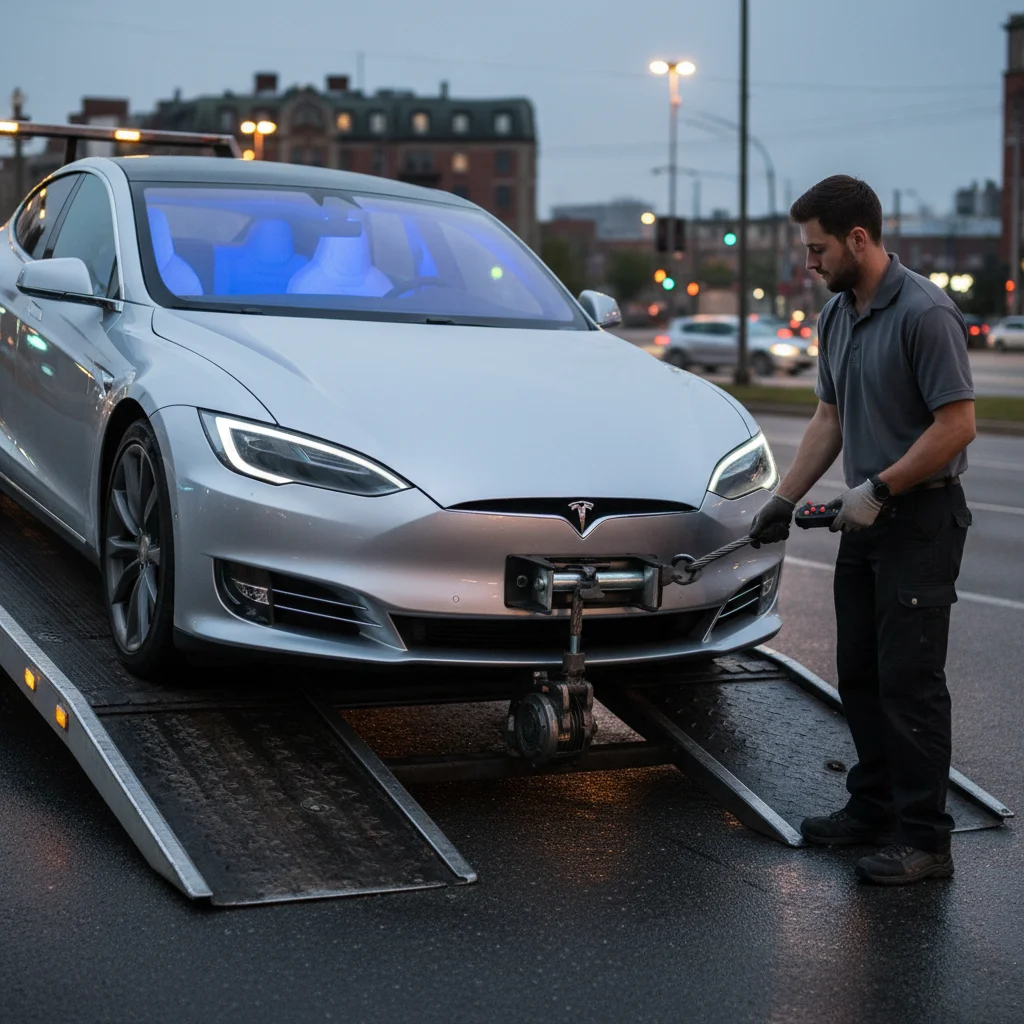
The cost is often comparable, especially when the tow would push past policy mileage limits. The time is shorter. The flatbed ride is rough on an EV’s drivetrain, and a wheel-lift tow is worse. A mobile boost skips the tow and the second wait at the public charger.
If the car is too damaged to drive, or the dash shows a high-voltage fault after a hard stall, a flatbed is the right answer. The operator will tell you when that’s the case. For a clean depletion, the mobile boost is faster.
Where Tesla depletion calls come up in this region
The Beltway leads the list. I-495 inside the District and around the American Legion Bridge sees the most depletion calls. A driver who misjudged the daily commute plus the cabin heat ends up on a shoulder at the worst time.
I-95 through Springfield and Alexandria is a close second. The mix of long-haul traffic and commuter crawl produces the same pattern. I-66 inside the Beltway during afternoon rush hour has the same shape.
I-270 up through Rockville and Gaithersburg produces the climb-out depletion. A driver who left home low runs short on the long climb north. The cabin heat on a cold morning eats miles.
The Dulles Toll Road and the Dulles Greenway produce the airport-run depletion. A driver heading to the airport with just enough charge for the trip finds the airport garage charging full or the connector not fitting. They turn around short and stop on the shoulder.
Public motorist patrols don’t charge EVs
In this region, public roadside patrols help with flats, lockouts, and short traffic control. They don’t bring a 240-volt source.
VDOT’s Safety Service Patrol covers Virginia interstates including I-95, I-64, I-81, I-85, and I-66. In Northern Virginia, the I-66 corridor is covered, with the I-66 shoulder/express operation running weekday peak windows. Drivers reach help through Virginia 511. VDOT describes incident clearance and short-term traffic control, not EV charging.
Maryland’s CHART Emergency Traffic Patrol operates around the clock in the Baltimore/Washington metropolitan area. CHART techs change tires, jump 12-volts, and add gas or water. Dial #77 for a breakdown on state primary roadways like I-495, I-270, US-50, and MD-295. Published CHART pages don’t describe charging an EV.
The District has no DDOT motorist-assistance patrol in the pages reviewed. DC drivers rely on MPD, a private plan, or US Park Police on the parkways.
On the 495, 95, and 395 Express Lanes, Express Assist helps with minor mechanical issues and will call a tow. It doesn’t tow, and it doesn’t charge the pack. Stay in the car until help arrives.
Frequently asked questions
What happens if my Tesla hits 0% on the highway?
The car still has a few seconds of motion after the range hits zero. Use that window to reach a shoulder, an exit, or a parking lot. Set the hazards. Stay in the car. Place the call.
Can I get a tow to the nearest Supercharger instead?
Yes, but the tow takes the car somewhere else to wait. A mobile boost brings 240-volt Level 2 to where the car sits. The cost is often comparable and the time is shorter. The flatbed ride is also rougher on the drivetrain.
How long does a Tesla mobile boost take?
Typical charging time adds 10 to 20 miles of range in 15 to 30 minutes. That’s charging time, never an arrival time. The operator unplugs when enough range is in to clear the shoulder or reach a charger.
What if the Tesla’s screen is fully dead?
The 12-volt may be the underlying issue, not the traction pack. Tell the operator what the cabin is doing. A dead 12-volt and a dead traction pack look similar but require different fixes. The operator brings the right gear for either.
Can the operator charge my Tesla on a shoulder safely?
Yes, for shoulder calls the operator sets up behind the car, away from traffic, with their own hazards on. If the shoulder is too narrow or the conditions are unsafe, they will tell you. A safe spot matters more than a fast boost.
If your Tesla hits zero anywhere we serve, from the Beltway to I-66, call Charge Pro DC at (202) 629-0844. Stay in the car, set the hazards, and tell the operator where you are.