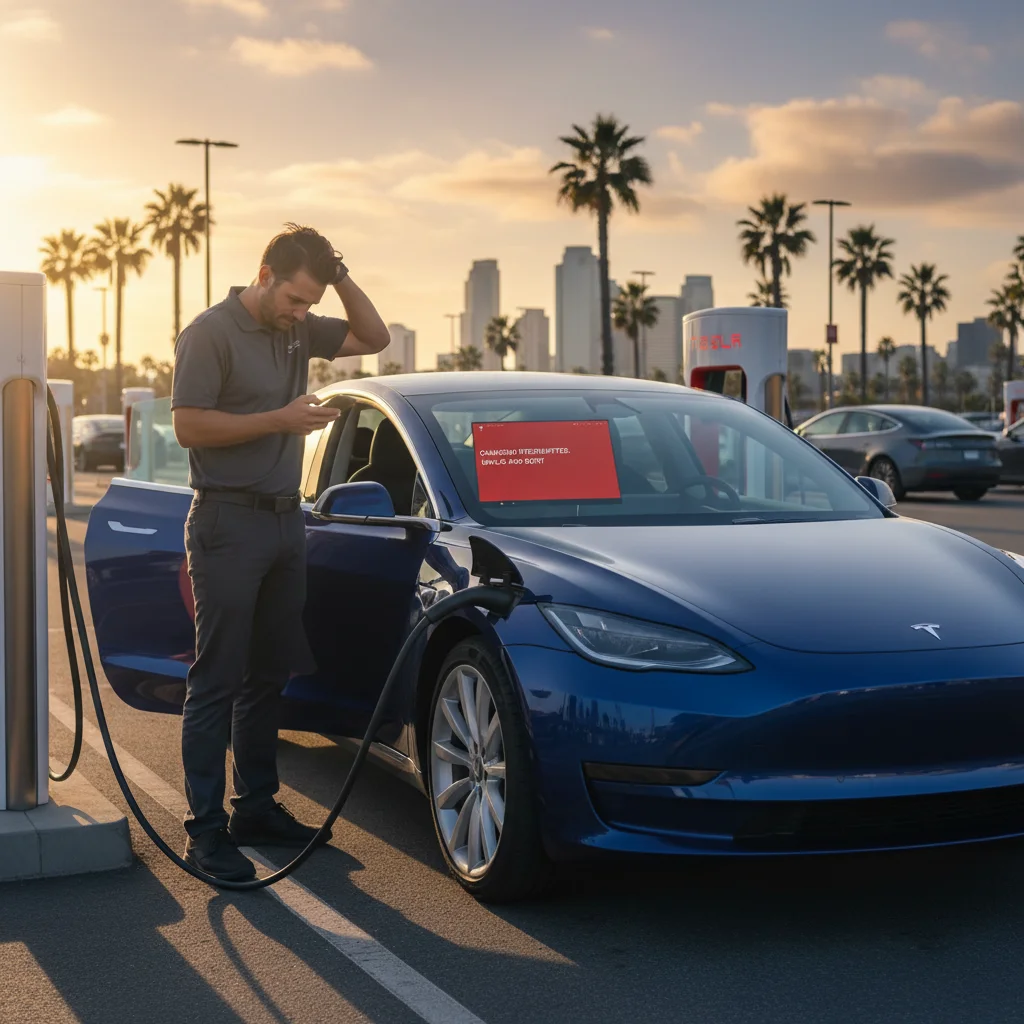
You planned to charge at a Supercharger along I-66. The stall is full or the station is offline. Your state of charge is in the single digits. Centreville, Manassas, Gainesville, Haymarket, and Fairfax are all options, but only if your range actually covers the next exit. If it does not, you are about to be the car that stops on the I-66 shoulder. This post walks through how to handle a failed charge stop on the I-66 corridor, the Northern Virginia geography that shapes the decision, and when a local mobile operator is the smarter move than gambling on a backup stall.
Why I-66 plan-and-charge plans fail
The I-66 corridor inside the Beltway is a managed lanes road with peak-direction tolling, and outside the Beltway it is a traditional interstate with HOV rules and shoulder-running during weekday peak windows. The traffic patterns shape every charge plan.
Station full is the everyday failure
Northern Virginia has a high concentration of Teslas commuting from the outer suburbs to Arlington, Fairfax, and the District. The I-66 Superchargers at Manassas, Gainesville, and Haymarket sit full during weekday evenings. The Centreville and Fairfax stops fill up around lunchtime on weekends. A planned 20 minute stop can become an hour wait, and that hour burns range if your cabin climate control is running.
Station down is the rarer failure
A station going dark usually traces to a grid event, a hardware failure, or vandalism. The VDOT Safety Service Patrol covers I-66 between the Beltway and the western suburbs. That patrol handles vehicles that stop moving on the shoulder, not charging stations that go offline. For a station outage you have to read the Tesla app or a third-party app to see whether the station is marked up or down.
Backups drain range faster than distance suggests
The I-66 backup eastbound in the morning and westbound in the evening is stationary for stretches. A driver who tried to “limp” to a backup station on I-66 west of Manassas can lose more range to AC load than they pick up from rolling. The pack drops without the miles adding up. That math is what turns a planned charge stop into an emergency.
Read the situation before you move
Pull into a safe spot if you can. A Centreville park-and-ride, a Manassas Mall lot, a Fairfax County Parkway lot, or a Haymarket shopping center are all safer than the I-66 shoulder. Once stopped, look at three things.
What does the navigation say
The Tesla navigation will route you to the next nearest working charger if the planned stop is offline. Trust the range calculation, but understand it does not account for unexpected traffic on I-66 or for the stationary drain of running the cabin heat or AC. If the navigation says you will arrive at 2 percent, that is a serious gamble. If it says you will arrive at 15 percent with the climate off, you have room.
What does the Tesla app say
The app sometimes shows an estimated time for a station to come back online. If it is a 15 minute software reboot, it may be worth waiting at the current stall or at a nearby lot. If it is a hardware failure with no ETA, you need a Plan B.
What is your state of charge really
Single digit state of charge with no working charger in reach is the danger zone. You do not have time to drive 15 miles east to a Tyson Corner backup. You need a decision in the next few minutes. If you can stop safely somewhere with cell service, that is your window to call.
Backups along the I-66 corridor
The Northern Virginia suburbs I-66 serves all have a mix of DC fast charger options outside the Supercharger network. The catch is that reaching them from an I-66 shoulder stop takes range you may not have.
Centreville and Chantilly
The I-66 and Route 29 interchange is a backup hub. Electrify America and EVgo stations cluster around the shopping centers just off the interstate. From a stalled position on I-66 westbound, reaching Route 29 takes a careful exit at Centreville. If your state of charge can cover the climb up to the Route 29 exit, you can limp to a working DC fast charger.
Manassas and Manassas Park
The Manassas area has fewer fast chargers than Centreville, but the local Supercharger is usually less crowded than the I-66 stops. If you can reach the Manassas exit, the charging options expand. The pros and cons of each route are local enough that the driver has to read the signs at the time.
Gainesville and Haymarket
These are the outer suburbs. A driver who committed to charging at a Haymarket Supercharger and finds it down has limited options inside the immediate area. Heading east toward Manassas is the usual fallback. Heading west on I-66 toward the foothills gets you farther from any working charger.
Fairfax and the Inner Beltway
For a driver already inside the Beltway, Fairfax City, Merrifield, and the Vienna area all have multiple DC fast charger options. The Tyson Corner and Merrifield stations often have CCS adapters that work with the right Tesla adapter. The trick is reaching them without using up your last miles.
When mobile rescue beats waiting for a stall
Waiting is not always an option, and driving to a backup is not always safe. This is the moment to stop thinking about charging stations and start thinking about roadside rescue.
Consider these scenarios:
- You arrived at a dead Supercharger with less than 5 percent battery and the next nearest station is more than 10 miles away.
- You have a time-sensitive need, a flight out of IAD, a meeting in Arlington, or a medical appointment at a Fairfax hospital, and you cannot afford to wait for an unknown station restoration.
- The station is down, it is late at night, and you do not feel safe waiting at the Manassas or Haymarket lot.
- Your car is already showing low-power warnings and you are worried about being stranded on the I-66 shoulder between exits.
In these cases the smart move is to stop where you are and call. A flatbed tow to the next charger is slow. A local mobile operator brings a 240 volt Level 2 source to where you sit. Fifteen to thirty minutes of charge adds 10 to 20 miles. That’s charging time, not an arrival promise. It’s enough to reach your next plug or drive home under your own power. Our mobile EV charging service describes the dispatch path. For the broader decision when the traction pack is empty, our out-of-charge recovery service covers the same flow.
Three-jurisdiction note for the I-66 corridor
The I-66 corridor runs through three jurisdictions. The portion inside the Beltway is in Arlington and Fairfax. The portion between the Beltway and Gainesville is in Prince William and Fauquier. Virginia law applies to all of it, so the Virginia statewide tow cap and the Northern Virginia Planning Districts 8 and 16 tow floor both matter if you end up needing a tow instead of a charge. If you are heading east on I-66 toward the District, you cross into DC only after you exit at one of the Potomac River crossings.
For a dead traction pack instead of a dead Supercharger, our general out-of-charge guide for the DC area walks through the same decision tree.
When to call Charge Pro DC
If you are stuck at a dead Supercharger along I-66 with too little range to make the next station, do not wait for the battery to hit zero. The shoulder of I-66 between Manassas and Centreville, or between Centreville and the Beltway, is not a place you want to be sitting at zero percent. It is faster, safer, and less stressful to get a direct charge right where you are.
Stranded on I-66 between the Beltway and Haymarket with a dead Supercharger plan and a low pack, call (202) 629-0844. We match you with a local Northern Virginia operator who brings 240 volt Level 2 to your car. The operator quotes you before starting and bills you directly.