Tesla’s battery warranty covers defects in materials or workmanship, and it covers capacity loss past a defined threshold within a defined window. It does not cover a stranded Tesla on the shoulder of the Beltway. The warranty is a factory repair contract, not a roadside rescue plan.
Tesla publishes the warranty terms for each model on its website. The numbers and windows differ by model year and trim. Read yours before you assume what applies. Charge Pro DC isn’t a warranty administrator. We don’t speak for Tesla. The operator we connect you with doesn’t honor warranties. The operator quotes you before any cable goes in, and bills you directly.
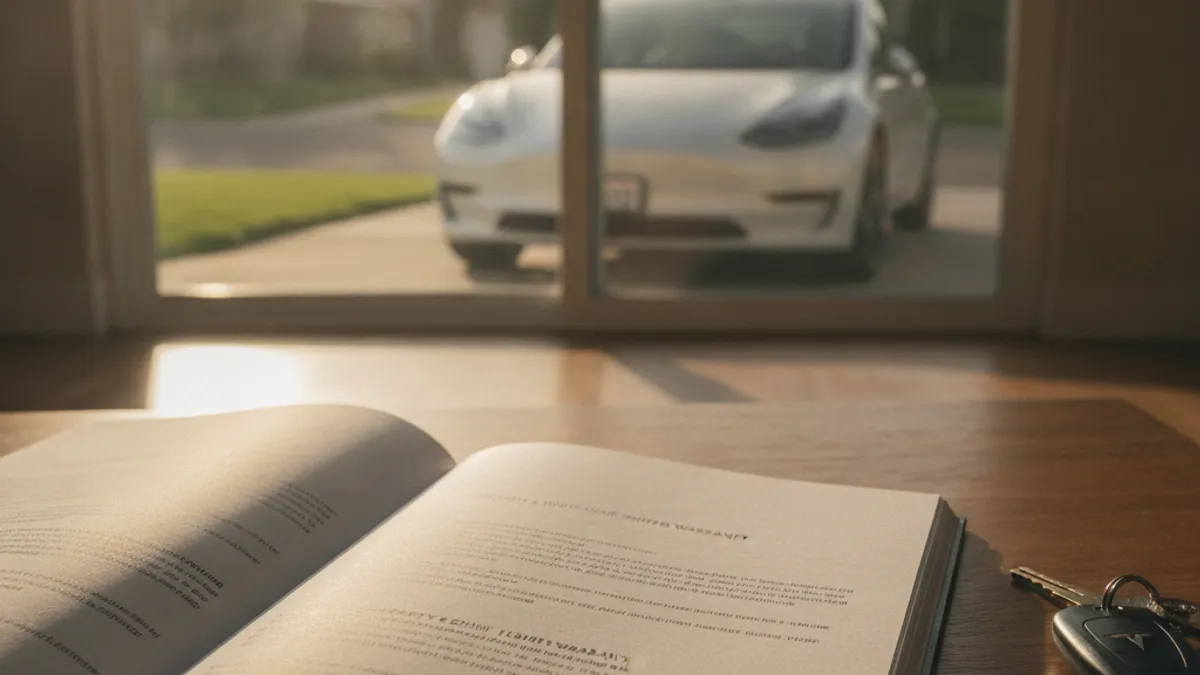
What Tesla’s battery warranty actually covers
Tesla’s New Vehicle Limited Warranty includes a separate Battery and Drive Unit Limited Warranty for the high-voltage pack and the drive unit. The coverage extends for a defined number of years or miles, whichever comes first. The current published terms vary by model.
Model S, Model X, and Model 3 Long Range and Performance trims historically carry an 8-year or 150,000-mile coverage window, with retention of at least 70 percent of capacity over that period. Model 3 Standard Range and Standard Range Plus trims historically carry an 8-year or 100,000-mile window. Model Y follows the same pattern as Model 3 by trim.
The warranty covers the repair or replacement of a pack or drive unit that fails due to a defect in materials or workmanship. It also covers capacity loss past the published retention threshold during the warranty window, when confirmed by Tesla’s diagnostic process.
What the warranty does not cover
The warranty does not cover roadside rescue. A Tesla that runs out of charge on I-395 or won’t wake up in the Reagan National Garage is not a warranty case. The warranty is a repair contract.
The warranty does not cover normal capacity loss within the retention threshold. Every EV battery loses some capacity over time. Tesla’s published retention numbers are the floor, not the target.
The warranty does not cover damage from accidents, misuse, or unauthorized modification. A Tesla that took on water in a flood, or a Tesla with a high-voltage system that was opened by an unqualified shop, is outside the warranty.
The warranty does not cover a 12-volt battery failure past the new-vehicle basic warranty window. The 12-volt is a wear item. Tesla’s roadside or service network can replace it. The cost is on the owner past the basic coverage window.
The warranty does not cover service appointments for problems that aren’t defects. A driver who arrived at a Supercharger with a car that can’t accept the rate, when the cause is a charge-port door sensor wearing out, is on the owner’s tab.
What to do when a Tesla is stranded
Warranty talk doesn’t recover a car on the shoulder. The right call is to a quoted local operator who can get the car moving under its own power.
If the cabin is dark, the 12-volt is the suspect. A jump on the labeled under-hood terminals is the first fix. Many Tesla 12-volt calls clear with a jump. A 12-volt that won’t hold needs replacing on site. The operator quotes the work before it starts.
If the dash is up and range is gone, the traction pack is the problem. The operator brings 240-volt Level 2 to the car. A native NACS plug covers all current Teslas. Typical charging time adds 10 to 20 miles in 15 to 30 minutes. That’s charging time, never an arrival time.
If the car shows a high-voltage fault or a persistent warning after a solid 12-volt jump, stop. That’s a dealer scan, not another roadside cycle.
The Tesla 12-volt is the most common stranded-Tesla story
Tesla switched the Model S and Model X auxiliary battery to a lithium-ion pack around 2021. The Model 3 and Model Y followed. Lithium 12-volts hold voltage better in storage than lead-acid, but they also fail without warning in some cases. The car looks completely dead.
The pattern in this region is the same as every other EV. A Tesla that sat in a Dulles Economy Lot for a week. A Tesla in a Bethesda apartment garage through a long workday. A Tesla in the Reagan National Garage while the owner flew to California for five days. The pack is fine. The 12-volt gave up. The operator jumps it at the stall.
What a quoted operator visit looks like for a Tesla
Tell the operator what the cabin is doing. They bring the right gear for a Tesla 12-volt jump and a NACS Level 2 charge. For a 12-volt jump, they connect to the labeled under-hood terminals. For a charge visit, they plug the native NACS connector into the Tesla’s charge port. They monitor the session. They unplug when enough range is in. You drive off.
Charge Pro DC matches the stranded driver with an independent local operator. We don’t perform the work, own trucks, or employ technicians. The operator quotes you before starting and bills you directly. They don’t honor Tesla’s warranty. They don’t dispatch Tesla Service. They get the car moving so the driver can decide what to do next.
Where Tesla 12-volt and dead-pack calls come up in this region
The Beltway and I-270 are the loudest corridors. A slow afternoon crawl with the cabin heat on drains a pack without covering miles. The same crawl with a near-empty battery leaves a Tesla on the shoulder at the worst possible time.
The Dulles and Reagan garages produce the trip pattern. A traveler who parks for a week comes back to a Tesla that won’t wake. The pack still shows range. The 12-volt is dead.
Around the District, apartment dwellers in Capitol Hill, Logan Circle, and Dupont Circle run the curbside pattern. Cars sit at the curb through cold nights. A weak 12-volt quits by morning.
Frequently asked questions
Does Tesla’s battery warranty cover roadside rescue?
No. Tesla’s warranty is a repair contract for defects in materials or workmanship, plus capacity loss past the published threshold. It does not cover a stranded Tesla, a 12-volt replacement past the basic warranty window, or a roadside charge.
What does the 8-year or 150,000-mile Tesla battery warranty actually cover?
It covers repair or replacement of a pack or drive unit that fails due to a defect in materials or workmanship. It also covers capacity loss past the published retention threshold during the warranty window, when Tesla’s diagnostic process confirms it. Confirm the exact terms for your model year and trim on Tesla’s site.
Is a dead 12-volt covered under Tesla’s warranty?
The 12-volt is covered under the New Vehicle Limited Warranty for the basic coverage window. Past that window, the 12-volt is on the owner. A quoted local operator can replace it on site.
Where can I see my Tesla’s specific warranty terms?
On Tesla’s website, in your Tesla account, and in the warranty booklet that came with the car. The numbers and windows differ by model year and trim. Read yours before you assume.
If a Tesla is dead anywhere we serve, from the Beltway to Dulles, call Charge Pro DC at (202) 629-0844. Tell the operator what the dash is doing and where the car sits.