Geico roadside assistance will jump a dead 12-volt on your EV in DC, Maryland, or Virginia. It will also arrange a tow. It will not bring a 240-volt source to a dead traction pack. Knowing that gap up front saves an afternoon.
A lot of drivers around here carry Geico. Some through a parent policy, some through the gecko. The plan works the same way for an EV as it does for a gas car, which is both its strength and its limit. If your Tesla runs out of charge on the Beltway, Geico dispatches a contractor. That contractor has a flatbed and a jumper pack, not a Level 2 charger. You either get a jump and drive away, or you get a ride to a plug.
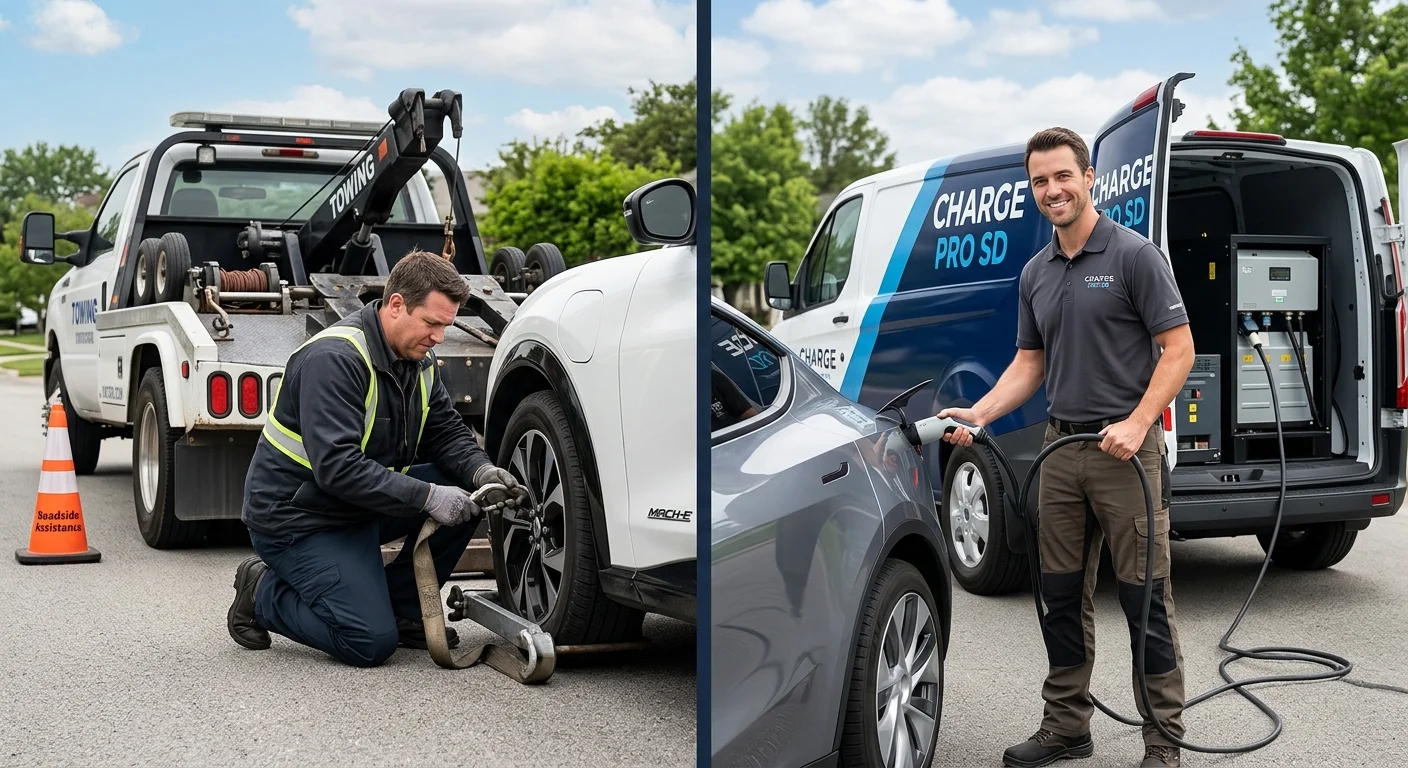
What Geico’s roadside assistance actually covers for EVs
Geico’s roadside assistance is sold as an add-on or bundled with some policies. It covers the usual list: flat tires, dead 12-volt batteries, lockouts, fuel delivery, and towing. For an EV, that means a jump if the small battery has dropped below threshold. The traction pack is untouched in that case. The jump wakes the modules, the contactors close, and the car drives.
If the pack itself is the problem, Geico’s standard move is a tow to the nearest public charging station or a repair shop. There’s no portable Level 2 kit on that dispatch. You’re being moved to a plug, not given power where you’re parked. The “nearest” charger in the dispatcher’s database may not be close, and may not be a fast charger.
The problem: they dispatch a traditional tow truck
One of the main challenges EV owners face with conventional roadside assistance, including Geico, is the dispatch of a standard tow truck. Most insurance companies contract with a broad network of towing providers. Many of those providers are equipped for traditional gas cars, not the drivetrains of modern EVs.
Towing an EV with its drive wheels on the ground can risk damage to the electric motors, the transmission, or the regenerative braking system. Modern EVs are designed to be flatbed towed to prevent those issues. When you’re stranded on a busy freeway, perhaps on I-95 near the Springfield interchange, or on I-66 inside the Beltway, waiting for the right type of truck can add significant stress. The dispatch process often focuses on the fastest available tow, not the most EV-appropriate one. You could end up waiting longer or needing to specifically request a flatbed, which may not be guaranteed.
Will they tow you to a charger? What are the limits?
Yes. If your EV is out of charge, Geico will typically tow it to the nearest public charging station or a repair shop. Many policies have a maximum towing distance. The “nearest” charger might not be the most convenient, the fastest, or even fully operational. What happens if the closest charger is a Level 2 station and you need a quick DC fast charge to get back on the road efficiently. What if the charger is occupied, out of order, or requires a different adapter than your car carries.
These limits can turn a simple tow into a multi-step ordeal. You get towed to a location, then you wait for the car to charge. That’s waiting for the tow, the tow itself, and a long charging session after. It’s a significant time investment when all you wanted was enough range to reach the next exit.
Comparing wait times and outcomes: Geico vs. a quoted EV operator
When your EV is stranded, time matters. The typical path with Geico goes like this: call the general roadside line, wait for a standard tow truck dispatch that varies by location and availability, watch the truck arrive and transport your car to the nearest plug, and then wait through a Level 2 or DC fast charging session.
That sequence can stretch hours. A mobile EV charge is a different shape. The operator we connect you with brings a 240-volt Level 2 source directly to your car. They plug in where the car sits. Typical charging time adds 10 to 20 miles in 15 to 30 minutes. That’s enough to clear a shoulder, finish a commute, or reach a working charger on your own. You skip the tow, the ride, and the second wait.
Where Geico calls cluster in this region
Most Geico EV calls in DC, Maryland, and Virginia come off the major corridors. The Beltway sees the worst traffic in the region, and a slow crawl with the cabin heat on drains a pack without covering miles. I-95 through Laurel and up toward Baltimore runs the same pattern. I-66 inside the Beltway can stall in afternoon traffic. I-270 up through Rockville and Gaithersburg turns into a stationary drain on bad days. Every one of those is a place where Geico dispatches a tow, and the nearest plug may not be close.
Then there are the lots. Reagan National’s Garages 1 and 2 put Level 1 charging on Level 1, complimentary and first-come. Dulles’ Garage 1 and Garage 2 have Level 2 at no extra charge, but the Economy Lot has nothing. A car that sat in the Economy Lot for a week comes back to a dead 12-volt. The pack may still have range. The Geico jump fixes that. The Geico tow would be the wrong call.
Why a mobile charge is often faster than your ‘free’ insurance tow
Many Geico policyholders see their roadside assistance as free because it’s part of the policy package. For a dead EV, the “free” tow often comes with hidden costs and delays.
Time is the first one. The multi-step process of waiting for a tow, riding the tow, and then waiting for a charge at a public station can consume hours of your day. For someone on a schedule, that lost time is more costly than the fee for an immediate mobile charge. The vehicle preservation question is the second. Knowing your EV is being handled by professionals with the right equipment specifically for electric vehicles protects your investment. An EV that gets dragged with its wheels down the road is a flatbed ticket in the long run, whether it limps home today or not.
In short, while Geico’s roadside assistance is a valuable general service, for the specific problem of an out-of-charge EV, a quoted mobile charging solution is often faster, more direct, and more efficient.
When to call us
If your EV is out of charge in DC, Maryland, or Virginia, don’t wait on a tow. Charge Pro DC matches you with a local operator who brings 240-volt Level 2 to the car. Call (202) 629-0844 and leave your location and vehicle. The operator contacts you directly with a quote before any cable goes in.
Frequently asked questions
Does Geico cover on-site EV charging?
No. Standard Geico roadside doesn’t include on-site charging. For an empty pack, the plan arranges a tow to a plug, not a charging rig.
Will Geico jump my EV’s 12-volt battery?
Yes. A dead 12-volt is treated as a standard jump-start call. If the jump doesn’t resolve it, Geico can arrange a tow from there.
What’s Geico’s towing distance limit for an EV?
Geico sets the limit by policy and state. Confirm the exact distance with Geico directly. Out-of-mileage charges on a long tow from a Beltway shoulder to a fast charger add up.
Should I request a flatbed for my EV?
Yes. Most EVs need the wheels off the pavement. Ask the Geico dispatcher to send a flatbed before the truck is assigned. Don’t assume a wheel-lift is safe for your drivetrain.
How is a mobile EV charge different from a Geico tow?
The operator we connect you with brings 240-volt Level 2 to the car, on the shoulder, in a lot, or in a driveway. The car charges in place. You drive away instead of riding a flatbed and waiting at a public charger.
If your EV is dead anywhere we serve, from the Beltway to I-66, call Charge Pro DC at (202) 629-0844. Tell us what the dash is doing and where the car sits.